

Attorney Advertising. This post is for general informational purposes only and does not constitute legal advice. No attorney-client relationship is formed by reading this content. Past results do not guarantee similar outcomes in future cases.
Robocalls and automated texts from lenders are among the most frequent consumer complaints in the U.S. In fact, according to April 2025 FCC data, these accounted for 21% of all robocall complaints submitted by consumers, the largest single category, far exceeding health insurance scams, IRS impersonators, or solar energy fraud. Laws around automated communication place clear limits on how financial companies can use automated calling and messaging systems. But figuring out when a lender’s outreach crosses the line isn’t always simple; it often depends on the type of technology being used, the nature of the message, and whether proper consent was given. While some automated alerts are completely legitimate, others become problematic when they turn repetitive, intrusive, or go beyond what the law allows.
To help you protect your rights and spot potential violations, let’s break down the specific types of lender communications that are completely unlawful, the key exceptions you need to know, and how to hold violating companies accountable.
Robocall TCPA Lender Compliance GuideRobocalls and automated texts from lenders are regulated under the TCPA based on consent, message purpose, and delivery method. Marketing calls and robotexts require prior express written consent, while debt collection and servicing messages may be limited or conditionally permitted. Illegal practices include calls without consent, post-revocation contact, spoofed caller ID, and AI-generated voices without authorization. Exceptions apply for emergencies, manually dialed calls, and properly consented informational messages under federal robocall consent laws. |
Understanding Robocalls and Automated Texts From Lenders
Robocalls are automated phone calls using autodialers or prerecorded voices. On the other hand, automated texts work the same way as bulk messages, without any human involvement. Lenders use both to deliver payment reminders, debt notices, and loan offers. But not all of these communications are legal. The rise of illegal robocalls and automated texts has made it even harder for consumers to separate real lender communication from illegal spam activity, a challenge explored heavily in federal consumer telecommunications guides.
Comparison: Legitimate Lender Alerts Vs. Illegal Calls And Texts Under The TCPA
This breakdown reflects how TCPA illegal robocalls are identified and separated from legitimate lender communications.
Types of Robocalls & Automated Texts That Are Illegal in the USA
Two core federal laws shield loan takers from harassment: the TCPA, which strictly regulates the use of automated calling and texting technology, and the FDCPA, which governs the specific behavior and boundaries of debt collectors. The framework of robocall consent laws plays a major role in determining what contact is permitted.
Illegal Call & Text Types:
- No Consent Calls/Texts – Any autodialed or prerecorded call/text to your cell without your prior written consent is illegal. A lender buying your number from a third party doesn’t count as consent.
- Post-Revocation Contact -Once you say “Stop,” “Cancel,” or “Unsubscribe,” lenders must halt all automated contact within 10 business days. Every call/text after that is a separate violation
- Do Not Call Registry Violations – Lenders must check the registry every 31 days. Calling a registered number without consent is illegal.
- Wrong-Hours Contact -Automated calls or texts before 8 a.m. or after 9 p.m. in your local time zone are illegal. Note: some states (including Florida, Oklahoma, Oregon, Connecticut, and Texas) enforce narrower calling windows than the federal standard.
- Excessive Contact – Debt collectors cannot exceed 7 calls per week per account, regardless of consent, under Regulation F of the Fair Debt Collection Practices Act (FDCPA) — a separate statute from the TCPA.
- Spoofed Caller ID -Faking a phone number to appear local or legitimate violates the Truth in Caller ID Act.
- AI Voice Calls Without Consent – Since February 2024, AI-generated voices have been legally treated as prerecorded messages. No consent = illegal.
- No Caller Identification – Every robocall must state the company’s name and number at the start
- Missing Opt-Out Option – Prerecorded marketing calls must offer opt-out at the beginning, not the end.
Penalties per violation: $500–$1,500 (TCPA) | Up to $10,000 for intentional violations (TRACED Act). The FTC provides detailed enforcement examples of illegal robocalls, spoofing, and telemarketing violations under federal law.
Exceptions You Should Know According to the Law
Here are calls & texts that are legally allowed in the USA:
- Emergency Calls – Lenders can contact you automatically without consent if it involves genuine emergencies like fraud alerts or security breaches on your account
- Calls You Consented To – Any automated call or text within the scope of what you agreed to at loan signing (payment reminders, account alerts) is fully legal until you revoke consent
- Informational Calls With Oral Consent – For non-marketing calls like debt collection notices, verbal consent is enough; written consent isn’t required
- Financial Institution Calls -Financial institutions may place limited automated informational calls, as long as they comply with the Telephone Consumer Protection Act rules on consent and message type.
- Manually Dialed Calls – A real person manually dialing your number and speaking live is not a TCPA violation, regardless of consent
- One Post-Opt-Out Confirmation Text – After you text “STOP,” lenders may send a single confirmation text, but it cannot contain any marketing content
- Survey/Research Calls to Landlines – Non-commercial polling or market research calls to landlines are exempt
Even if a lender qualifies for a legal exception, consent does not automatically transfer to new loan servicers or different financial products, and any exempt automated call or text must stop immediately the moment you opt out by responding with “STOP”.
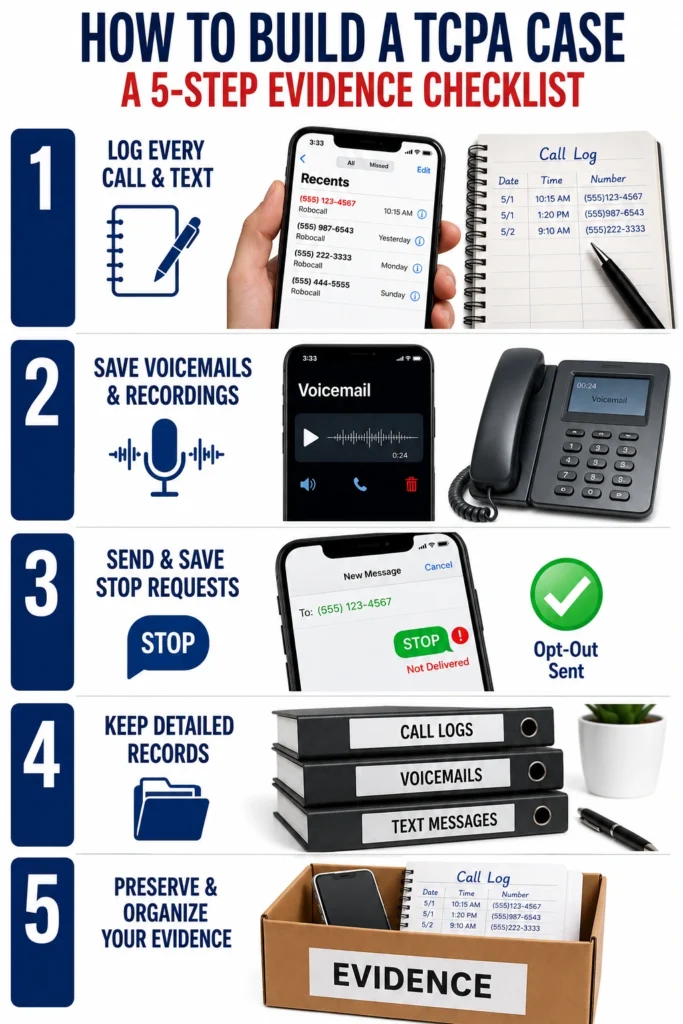
How to Build a TCPA Case: A 5-Step Evidence Checklist
If you are being pestered by illegal lender robocalls or automated texts, you do not have to handle it alone. Reach out to Zemel Law Consumer Protection, a dedicated firm that may be able to help you pursue the compensation you may be entitled to under the law.
This infographic outlines the exact steps to preserve evidence of illegal lender calls and texts, such as keeping a call diary and saving robotic voicemails. To turn these intrusive alerts into a powerful legal case, you must maintain a consistent record of your phone logs and the precise timing of your “STOP” requests. These documentation practices align directly with established federal litigation protocols for proving systemic violations, satisfying strict legal evidence standards, and TCPA requirements.
Final Takeaway
If you believe you are receiving unwanted or unlawful robocalls, our team is here to help you understand your options. Zemel Law specializes in defending loan takers against aggressive corporate outreach and illegal tracking. Contact us and let us Contact us to discuss your situation and learn about potential legal remedies that may be available to you.
Frequently Asked Questions on Lender Robocalls and TCPA Rules
Q1. What penalties apply for illegal robocalls?
TCPA violations can result in statutory damages per call or text, with higher penalties for willful or repeated violations under federal law.
Q2. Can lenders contact me if I only filled out a loan inquiry form online?
Yes, but only within the scope of consent given on the form. Broad marketing calls still require separate TCPA-compliant authorization.
Q3. Do banks and fintech apps follow different TCPA rules?
No. Traditional banks and fintech lenders are equally bound by TCPA rules when using automated dialing or prerecorded messaging systems.
Q4. Do lead-generation companies have TCPA liability?
Yes. Third-party lead generators are often jointly liable if they send consumer data or trigger automated lender calls without valid consent.
Q5. Can a lender text from multiple short codes legally?
Yes, but only if each messaging campaign has valid TCPA-compliant consent tied to the specific marketing purpose.
Disclaimer: This article provides general information about federal telecommunications law and is not a substitute for personalized legal advice. Laws referenced (TCPA, FDCPA/Regulation F, TRACED Act) are subject to change and may vary by jurisdiction. Zemel Law, LLC is licensed to practice in [insert applicable state(s)]. Results in past cases do not guarantee similar outcomes.
