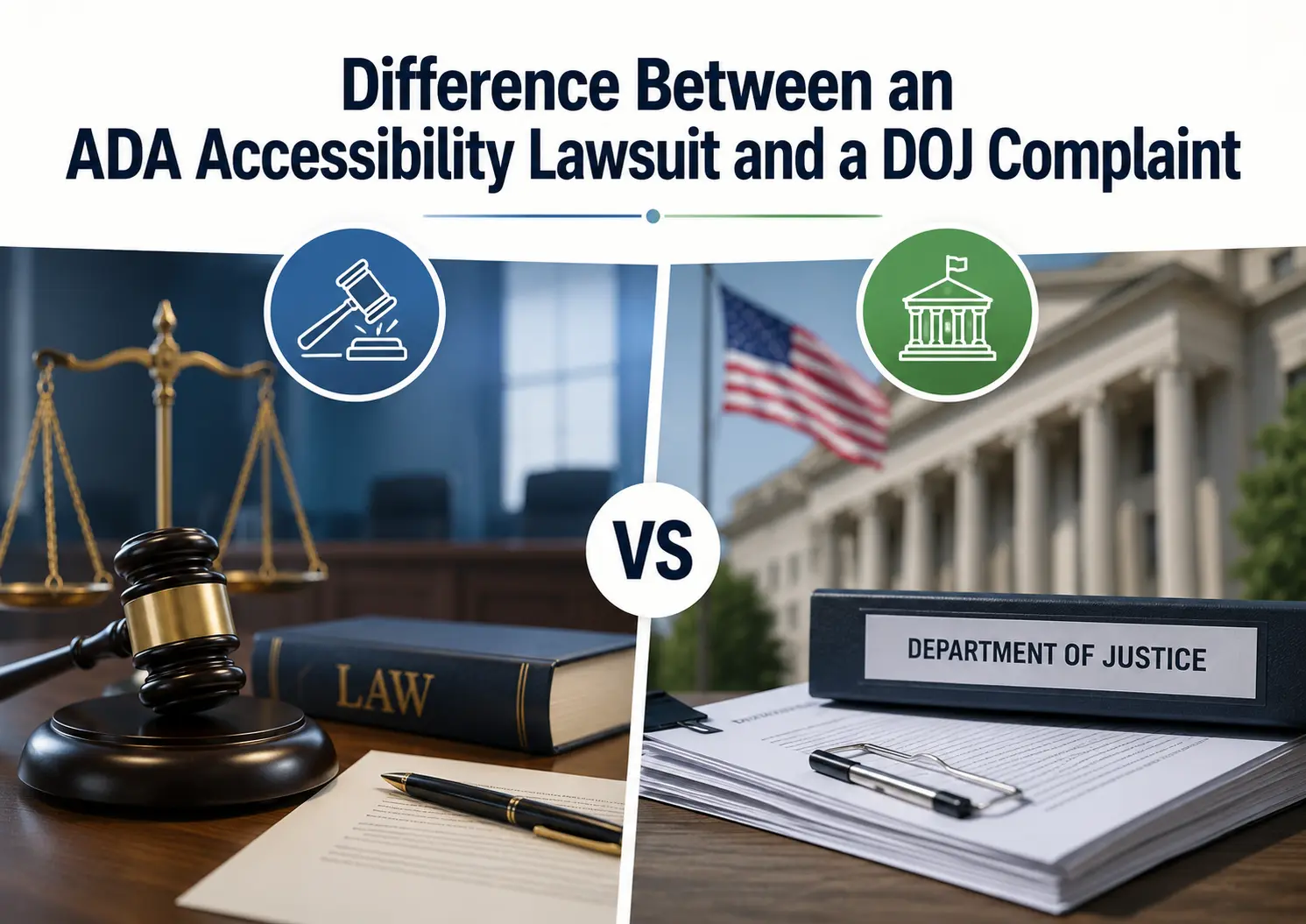

When a business fails to meet accessibility standards under the Americans with Disabilities Act (ADA), the first sign of trouble is often a letter, an email, or a phone call. At that moment, a natural question arises: Is this a lawsuit or a federal complaint? Though mentioned in the same breath, they’re entirely different legal processes. Here’s how:
- An ADA accessibility lawsuit is typically initiated by a private individual through the court system, often seeking damages.
- In contrast, a DOJ complaint is filed with a federal agency, which then investigates and determines whether enforcement action is warranted.
As ADA accessibility requirements are continuously expanding, understanding this distinction is essential for every business. In this guide, we will break down how each process works, what triggers each process, and how to respond and protect yourself going forward.
ADA Lawsuits vs. DOJ Complaints ExplainedTo summarize the differences between ADA and DOJ complaints, well, ADA accessibility lawsuit is filed by a private individual through the court system, often seeking damages and a court order for fixes, while a DOJ complaint is submitted to a federal agency that decides whether to investigate, mediate, or pursue enforcement. Lawsuits generally move more quickly and offer direct remedies but carry public exposure and higher costs, whereas DOJ complaints are free, confidential, and can trigger broader systemic change. Understanding both processes helps businesses respond effectively and reduce legal risk. |
What Is an ADA Accessibility Lawsuit?
Till now, we gave you a brief; now let’s give a full picture of what exactly an ADA accessibility lawsuit is.
It is a civil legal action filed when an individual believes that they are not provided equal access under the Americans with Disabilities Act. This could be caused by a business, an organization, or a public accommodation. Unlike a government investigation, this lawsuit is filed by a private individual under Title III of the ADA.
To bring a claim, the plaintiff must generally show that they personally encountered an accessibility barrier. And once that legal threshold is met, the lawsuit may proceed without prior notice in many U.S. states.
Note: Pre-suit notice or right-to-cure requirements vary by state and are evolving; businesses should not assume no advance notice will ever be given, as some jurisdictions now require or favor a notice period before a lawsuit is filed.
As online services continue to grow, ADA accessibility for websites has become an increasingly important consideration for businesses offering goods and services digitally.
What Is a DOJ Complaint Under the ADA?
A DOJ complaint is a formal report filed with the U.S. Department of Justice’s Civil Rights Division, alleging that a business, organization, or government entity has violated the ADA. In contrast to a lawsuit, this process doesn’t start in a courtroom. Instead, individuals can submit a complaint online, by mail, or by fax.
For a business, this often means learning about the complaint only after the DOJ has already begun its review, since there’s no requirement to notify the business beforehand. Complaints against private businesses generally fall under Title III of the ADA, while those against state or local government entities fall under Title II. If the DOJ decides to move forward, the business may be contacted directly and asked to provide records, respond to specific allegations, or accommodate a site visit as part of the review.
Once a complaint is filed, an investigator or attorney may be assigned to gather additional information, which can include document reviews, interviews, or site visits.
Key Differences Between an ADA Lawsuit and a DOJ Complaint
While both processes aim to address the same underlying issue, unequal access for individuals with disabilities, they differ in nearly every practical respect, from who controls the process to what a business can expect at the end of it.
| Factor | ADA Accessibility Lawsuit | DOJ Complaint |
| Who Controls the Process | The plaintiff and their attorney control the pace and direction of the case, including what evidence to present and when to escalate. | The individual largely steps back after filing. The DOJ decides whether to investigate, mediate, refer, or take no action. |
| Cost and Legal Representation | Typically involves legal fees on both sides; businesses often face substantial costs even in settled or dismissed cases. | Free to file and doesn’t require an attorney, since it’s simply a report submitted to a federal agency. |
| Timeline | Generally moves faster once filed, since courts operate on set procedural deadlines requiring a timely response. | May take considerably longer. Initial reviews alone can take up to three months, with full investigations stretching further. |
| Remedies and Outcomes | Can result in a binding court order, monetary damages, and recovery of attorney’s fees. | More often leads to mediation or a voluntary compliance agreement; financial compensation for the complainant is less common. |
| Legal Consequences for the Business | Businesses may face court-ordered injunctions requiring accessibility improvements, incur substantial remediation costs, and be required to pay the plaintiff’s attorney’s fees where permitted by law. In DOJ enforcement actions, courts may also impose civil penalties and other appropriate relief. Failure to address accessibility barriers may increase the risk of future legal claims and enforcement actions. | Consequences are typically non-monetary at first, such as a compliance agreement or remediation plan. However, if the DOJ finds a pattern of discrimination, it can pursue a formal settlement or civil lawsuit on the business’s behalf, which may include civil penalties, mandated policy changes, and court-ordered compliance monitoring. |
| Public Record vs. Confidentiality | Court filings are generally part of the public record, visible to competitors, customers, or the press. | Complaints and any resulting mediation are typically confidential. |
| Scope of Impact | Usually addresses one plaintiff’s specific experience with a business. | Can trigger a broader investigation if a pattern of discrimination is identified, potentially leading to systemic change. |
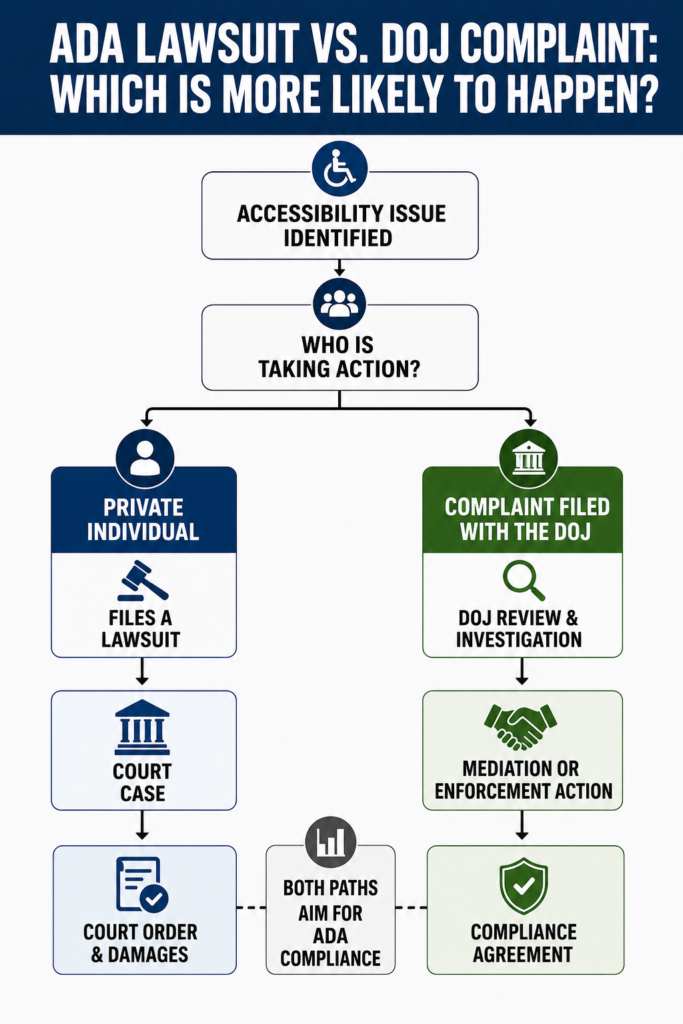
ADA Lawsuit vs. DOJ Complaint: Which Is More Likely to Happen?
Although both an ADA accessibility lawsuit and a U.S. Department of Justice (DOJ) complaint arise from alleged accessibility barriers under the Americans with Disabilities Act (ADA), they follow different legal paths. A private lawsuit is filed directly in court by an individual seeking legal remedies, while a DOJ complaint is submitted to the federal agency, which determines whether an investigation or enforcement action is appropriate. Understanding these distinct processes helps businesses respond effectively, reduce legal risks, and maintain long-term ADA compliance through proactive accessibility measures.
Conclusion
Navigating ADA compliance requires more than understanding the law; it requires responding promptly and strategically when accessibility concerns arise. Whether you’re facing an ADA accessibility lawsuit or a DOJ complaint, taking proactive legal action can help reduce risk and protect your business. Don’t wait until an accessibility issue becomes a costly legal dispute. The attorneys at Zemel Law are committed to helping businesses navigate ADA compliance, address accessibility claims, and develop effective legal strategies. Contact our team today to learn how we can help.
Frequently Asked Questions About ADA Lawsuits and DOJ Complaints
Q1. Can someone file a DOJ complaint and a lawsuit at the same time?
Generally, yes. Filing a DOJ complaint doesn’t prevent an individual from also pursuing a private lawsuit, since the two are separate, independent legal processes.
Q2. Does having an accessibility policy protect a business from lawsuits?
A written policy alone doesn’t guarantee protection. Courts and plaintiffs generally look at actual accessibility performance, not stated intentions, when evaluating compliance.
Q3. Can a business be covered under Titles I, II, and III of the ADA at the same time?
Title II of the ADA applies specifically to state and local government entities, regardless of whether they receive federal funding. Receipt of federal funding is the trigger for separate obligations under Section 504 of the Rehabilitation Act, not ADA Title II. A private business would not typically be “covered” under Title II unless it is itself a state or local government entity or operating on its behalf.
Q4. What is a “serial plaintiff” in ADA litigation?
A serial plaintiff is an individual who files numerous ADA lawsuits against different businesses, often targeting similar accessibility barriers across multiple defendants in a short period.
Q5. Are nonprofit organizations exempt from ADA lawsuits?
No. Nonprofits open to the public are generally treated as public accommodations under Title III and remain fully subject to ADA lawsuits and DOJ complaints.
| Attorney Advertising Disclaimer
This content is provided for general informational purposes only and does not constitute legal advice. It is not intended to create, and receipt of it does not constitute, an attorney-client relationship. Prior results do not guarantee a similar outcome, and the outcome of any legal matter depends on its specific facts and circumstances. You should not act or refrain from acting based on this content without seeking advice from a licensed attorney in your jurisdiction. |
Firm and Licensing Information
Zemel Law LLC | 660 Broadway, Paterson, NJ 07514 | (888) 508-7448 | Attorneys are licensed to practice in New Jersey, New York, California, Massachusetts, and Washington. This advertisement may be considered attorney advertising in certain jurisdictions.