
In 2025, consumers reported $15.9 billion in losses to fraud, according to the Federal Trade Commission (FTC), highlighting how important it is to understand the protections available when something goes wrong. That’s where knowing your consumer protection rights becomes crucial. These laws are designed to give individuals rights when businesses, creditors, or other entities engage in conduct that can affect their finances, personal information, access, or ability to make informed decisions. They not only prohibit harmful practices but also provide specific procedures for challenging violations and seeking appropriate remedies. In this guide, we will walk you through the key consumer protection rights you should know, helping you understand your legal options and determine what action may be available to you.
Consumer Protection Rights Every US Resident Should KnowThis guide covers six important areas of federal consumer protection law: identity theft and FCRA credit-report rights; FDCPA protections against debt collection harassment; mixed credit files and dispute remedies; ADA website accessibility and disability rights; TCPA protections against illegal robocalls and spam texts; and VPPA protections for video-viewing privacy and digital tracking. Each section explains applicable rights, violations, remedies, and important filing deadlines. |
Identity Theft and Your Credit Report: Federal Rights and Legal Remedies
A single stolen Social Security number can trigger fraudulent accounts, credit bureau failures, and legal remedies worth pursuing, each governed by a distinct part of the FCRA.
How Identity Theft Creates Fraudulent Tradelines and What the FCRA Requires Bureaus to Do
A fraudulent tradeline can appear when a thief uses someone’s stolen Social Security number or personal information to open a credit card, loan, or other account. The lender may then report that account to the credit bureaus under the victim’s name. Stolen information can pass through several stages before being used for fraud, as explained in from data breaches to dark web sales: the full journey of identity theft.
Under FCRA Section 605B, a consumer can ask the credit bureau to block information resulting from identity theft. The consumer generally must provide proof of identity, an identity theft report, identify the fraudulent information, and state that they did not make the transaction. Once the required information is received, the bureau generally must block it within four business days and notify the lender that reported it.
FCRA Violation Categories: Failure to Block, Failure to Investigate, and Furnisher Liability
FCRA violations involving identity theft can generally arise from three different failures:
- Failure to block: A credit bureau does not block qualifying identity-theft information within the required timeframe.
- Failure to investigate: A bureau does not reasonably investigate a consumer’s dispute or correct information that is inaccurate or unverifiable.
- Furnisher liability: A bank, lender, or other furnisher continues reporting fraudulent information as accurate after receiving proper notice of the dispute.
These distinctions matter when assessing a potential claim, as you should know your legal rights before seeking identity theft lawyer help, along with identifying the parties responsible for the violation so you can take prompt action.
Statutory Damages, Two-Year Filing Window, and the No-Cost Legal Path for Victims
Consumers who discover fraudulent accounts on their credit reports may have legal remedies if a credit bureau or furnisher violates the FCRA. The type and amount of recovery depend on the violation. Consumers may recover actual damages for harm caused by the violation, while willful violations can also support $100 to $1,000 in statutory damages without requiring proof of actual financial loss. Punitive damages may also be available in appropriate cases, along with reasonable attorney’s fees and costs. In cases involving fraudulent accounts, you may also consider how a credit attorney can respond to identity theft fraud on a consumer’s behalf. An FCRA claim generally must be filed within two years after discovering the violation or five years after it occurred, whichever comes first.
If you want to know what steps can help prevent this from happening in the first place, check out 6 effective preventive measures to avoid identity theft risks.
Debt Collection Harassment: What Collectors Cannot Do and How to Fight Back
Not every aggressive collector crosses a legal line, but the FDCPA draws that line clearly, spelling out exactly which types of debt collection harassment are off-limits and what a consumer can do once one is crossed.
FDCPA Prohibited Practices: Harassment, False Representation, and Unauthorized Third-Party Contact
The FDCPA prohibits specific collection tactics, including repeated calls meant to annoy or harass, threats of arrest or wage garnishment without a legal basis, and false statements about the amount or status of a debt. Collectors also generally cannot discuss a consumer’s debt with an employer, family member, or neighbor, except in limited circumstances when seeking basic contact information. These protections cover several forms of conduct, and understanding the different types of debt collection harassment can help consumers recognize when a collector may be crossing these legal boundaries.
Consumer Rights Under the FDCPA: Validation Demands, cease, and Time-Barred Debt
Within five days of first contacting a consumer, a debt collector generally must provide written information about the debt, including the amount owed and the creditor’s name. The consumer then has 30 days to dispute the debt in writing, which generally requires the collector to pause collection activity until it verifies. A written cease-and-desist request can also require the collector to stop contacting the consumer directly, subject to limited exceptions. When a debt is already past the applicable statute of limitations, consumers should also understand when creditor harassment crosses the line under the FDCPA and what collectors can legally do.
Per-Case Damages Up to $1,000, Class Action Recovery, and One-Year Filing Deadline
Consumers may recover actual damages plus up to $1,000 in statutory damages for an FDCPA violation, even without proving financial loss. In class actions, additional statutory recovery can reach the lesser of $500,000 or 1% of the collector’s net worth, subject to the statute’s requirements. The FDCPA generally gives consumers one year from the date of the violation to file a claim, so documenting the date and nature of each unlawful communication can be important. This includes newer collection methods such as emails, texts, and social media messages, which are addressed in digital harassment in debt collection: spotting and defending.
Mixed Credit Reports: How They Happen and How to Force a Fix
Someone else’s debt can end up on your credit file through nothing more than a shared last name or a mistyped digit, and the FCRA gives you a specific process for forcing the bureau to remove it.
Mixed File Causes: Name Similarities, SSN Errors, and Bureau Matching Algorithm Failures
A mixed credit file’s impact on your credit reputation starts with a simple bureau error: mistakenly combining information belonging to two different consumers. Common causes include:
- Similar or identical names
- Incorrectly entered Social Security numbers
- Shared surnames with suffixes such as Jr. or Sr.
- Errors in the bureau’s matching process
The resulting file may contain another person’s accounts, balances, or payment history, and that damage rarely stays confined to a single line item, often leading to hidden risks of a mixed credit report that can extend across multiple accounts and an entire portfolio, which is part of why catching the error early matters.
Detection and Real-World Harm: Unfamiliar Accounts, Credit Denials, and Failed Background Checks
Consumers reviewing their credit report should watch for the same signs covered in how to address errors on your Experian credit report: unfamiliar accounts, sudden score drops, and other red flags that don’t add up:
- Unfamiliar accounts or debts they never opened
- An unexplained credit-score drop
- Credit denials based on information they do not recognize
- Incorrect information appearing in rental or employment background checks
Left unresolved, these warning signs can escalate into real financial harm. The Equifax mixed credit file: real consumer impact case shows how serious the consequences can become when incorrect information remains unresolved for years.
FCRA Dispute Rights, 30-Day Investigation Rule, and Damages When Bureaus Fail to Correct
Once a consumer disputes a mixed-file error, the bureau must forward it to the furnisher within five business days and complete a reasonable reinvestigation within 30 days, extended to 45 if the consumer submits more information during that window, or delete the unverifiable item. Preventing mixed credit report: steps to take for correction outlines what a dispute needs to include to start that clock. A bureau that misses the deadline or performs only a superficial reinvestigation, accepting a furnisher’s confirmation without independently checking it, has violated the FCRA and opened itself to the same damages available in Chapter 1: statutory damages of $100 to $1,000 for willful violations, plus actual damages and attorney’s fees.
ADA Website Accessibility Violations: Business Obligations and Disabled User Rights
A missing alt tag or an unlabeled form field can be enough to put a business on the wrong side of the ADA, well before anyone intended to discriminate against a disabled user.
Title III ADA and WCAG 2.1 Level AA: What Every US Business Website Must Meet
Title III of the Americans with Disabilities Act (ADA) prohibits covered businesses from discriminating against people with disabilities. For websites, accessibility means users with disabilities should be able to access services and information offered to other users. The ADA does not expressly establish WCAG 2.1 Level AA as its statutory standard, but WCAG is widely used as a technical framework for identifying accessibility barriers. The ADA web accessibility standards: what you need to know provides additional context on these standards.
Most Litigated Violations: Missing Alt Text, Inaccessible Forms, Absent Captions, and Poor Contrast
Common accessibility barriers include:
- Missing alt text that prevents screen readers from describing meaningful images
- Inaccessible forms that cannot be properly navigated or labeled
- Videos without captions that exclude users who are deaf or hard of hearing
- Poor color contrast that makes text difficult to read
- Keyboard navigation problems that prevent access to menus and controls
These barriers can interfere with everyday activities such as submitting forms, making purchases, or accessing account information. The risks of a non-ADA-compliant website every domain owner must know examines these risks in greater detail.
Injunctive Relief, Attorney’s Fees, and Why Overlay Widgets Do Not Satisfy Legal Requirements
ADA website claims may seek injunctive relief, requiring a business to address accessibility barriers. Prevailing plaintiffs may also recover reasonable attorney’s fees and litigation costs. Accessibility overlays and automated widgets can assist with certain issues, but their presence does not automatically make a website accessible or establish ADA compliance. Businesses generally need to address underlying accessibility barriers rather than relying solely on an overlay. The web content accessibility guidelines for ada website compliance provides further guidance on the technical principles commonly used to evaluate website accessibility.
Illegal Robocalls and Spam Texts: TCPA Rights and Per-Call Damages
One unwanted text can be worth hundreds of dollars under the TCPA, and the rules for what counts as a violation are more specific than most callers and most recipients realize.
TCPA Autodialer Rules, Prior Express Written Consent, and the Right to Revoke Permission
The Telephone Consumer Protection Act (TCPA) restricts certain calls and texts made using an automatic telephone dialing system or prerecorded voice, particularly to wireless numbers. The consent requirement depends on the type of communication: telemarketing generally requires prior express written consent, while certain non-marketing calls may require a different level of consent. Consumers can also revoke consent through reasonable means, and callers generally must honor a valid revocation request.
Most Common TCPA Violations: Unsolicited Texts, Post-Revocation Calls, and Debt Collector Autodials
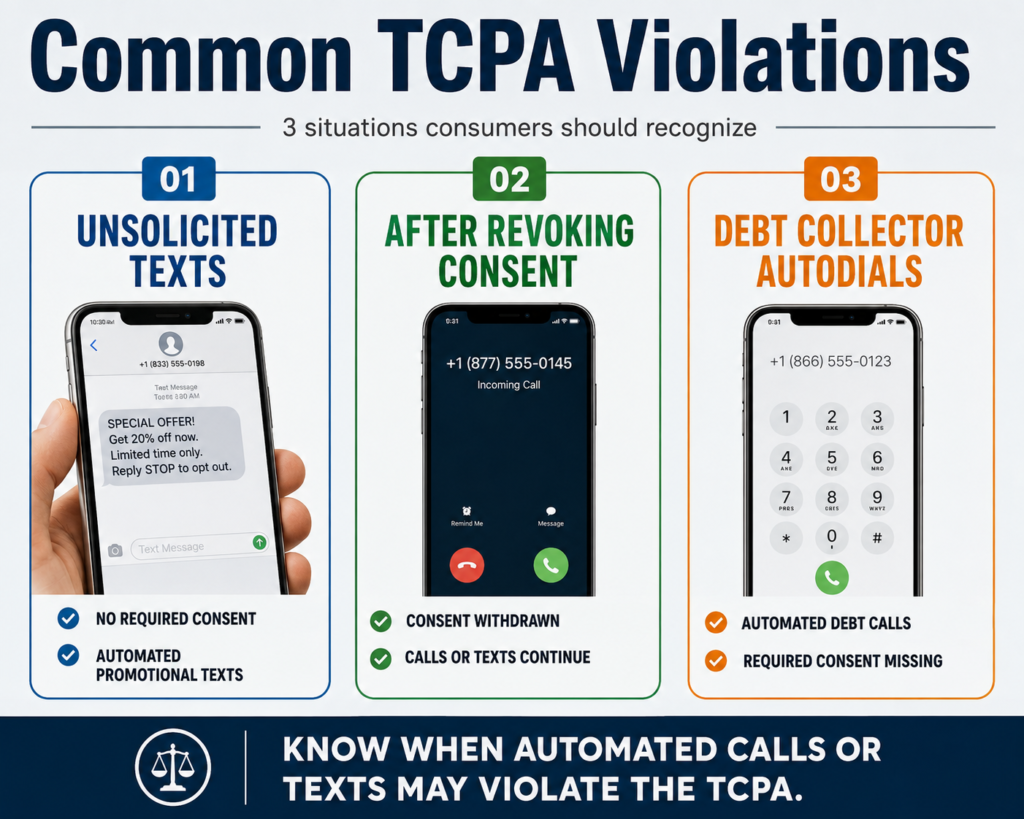
TCPA violations can occur when businesses send automated promotional texts without proper consent, continue contacting consumers after consent is revoked, or use autodialed calls for debt collection without meeting legal requirements. Borrowers dealing with this last category should also be aware of California’s new pen register rules: what borrowers must know, since these rules add another layer of protection around how their communications are tracked during debt collection. Recognizing these situations can help consumers understand when unwanted communications may cross the line into unlawful contact.
$500 to $1,500 Per Call, Class Action Structure, and Four-Year Filing Deadline
Consumers can generally seek $500 per TCPA violation, with damages increasing to $1,500 when the violation is willful or knowing. The TCPA also allows class actions when multiple consumers are affected by the same unlawful calling or texting practice and the legal requirements for class treatment are met. Most federal TCPA claims are subject to a four-year filing period, although specific provisions may involve different limitations rules. Because deadlines can affect whether a claim can be pursued, consumers should preserve call logs, text messages, consent records, and other evidence showing when and how the communications occurred.
Video Privacy and Digital Tracking Violations: Your VPPA Rights Online
A law written for video rental stores in 1988 now governs the tracking pixels running quietly behind today’s streaming and news sites, often without the visitor ever knowing their viewing activity moved anywhere.
VPPA Scope in the Digital Age: Streaming Platforms, News Sites, and Embedded Video Trackers
The VPPA was passed in 1988 to stop video rental stores from sharing customers’ rental records. Today, courts have applied the law to some websites and apps that provide video content, including streaming services, news sites, and retailers with embedded videos. Generally, VPPA coverage requires a relationship with the provider, such as a subscription or registered account, rather than simply visiting a website as an unregistered visitor.
How Facebook Pixel and Third-Party Tags Share Video Viewing Data Without Consumer Consent
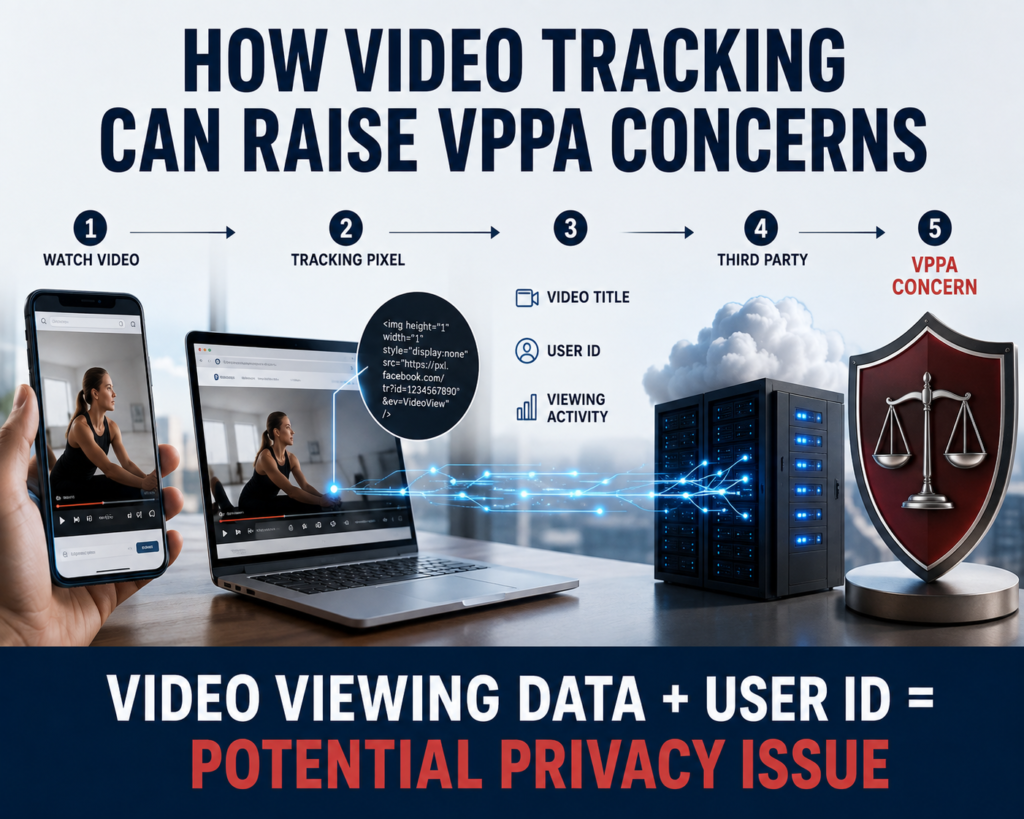
Many video-embedded websites use a tracking pixel, a small piece of code that runs silently in the background, to record what a visitor watches. When a logged-in visitor plays a video, the pixel can send the video’s title, along with the visitor’s user ID, to a third-party server, linking a specific person to specific viewing activity without their knowledge. The steps below show how that transmission typically happens.
Minimum $2,500 Per Violation, Punitive Damages, and Two-Year Filing Deadline
The VPPA allows consumers to seek at least $2,500 in liquidated damages for each violation, along with possible actual damages, punitive damages, attorney’s fees, and legal costs. Claims generally must be filed within two years of the disclosure or its discovery, making timely action important when privacy violations are difficult to detect.
Conclusion
Knowing which federal law applies is only the starting point; the next step is recognizing when a violation may require legal action. At Zemel Law, LLC, we help consumers pursue their rights in matters involving credit-report errors, identity theft, debt collection harassment, robocalls and texts, digital privacy, and website accessibility. Understanding your rights can help you recognize when legal remedies may be available.
|
Get legal guidance when consumer protection violations affect your credit, privacy, debt, or accessibility rights. |
Frequently Asked Questions About Consumer Protection Rights
Q1. What should I do if I find an account I never opened?
Start by reviewing the account details, documenting the suspected fraud, and checking your credit reports for other unfamiliar accounts or activity.
Q2. What happens if a credit bureau refuses to correct inaccurate information?
A consumer may have additional legal remedies when a bureau fails to reasonably investigate a properly submitted dispute or continues reporting information that is inaccurate or unverifiable.
Q3. What types of website features commonly create ADA accessibility problems?
Common barriers include forms, navigation menus, videos, images, color combinations, and interactive controls that cannot be properly accessed or understood by users with disabilities.
Q4. Can I revoke consent to receive marketing calls or texts?
Yes. Consumers can generally revoke consent through reasonable means. Businesses must then follow the applicable rules governing communications after revocation.
Q5. Is an FTC identity theft report the same as a police report?
No. An FTC report is filed online and used to invoke FCRA protections, while a police report documents the crime locally and may be separately required.
Q6. Does paying a small amount on an old debt restart the collection clock?
In many states, yes. Making a partial payment on time-barred debt can revive the statute of limitations, making it collectible again.
Q7. Can I legally record phone calls with a debt collector?
It depends on your state’s consent laws. Some states allow recording with one party’s consent, while others require all parties to agree.
Q8. Should I dispute a mixed credit file with the bureau or the creditor first?
Disputes typically start with the credit bureau reporting the error, since it’s responsible for investigating and forwarding the correction to the furnisher.
Q9. Are Equifax, Experian, and TransUnion files separate, or shared?
They’re separate. Each bureau maintains its own file, so a mixed-file error at one bureau doesn’t necessarily appear at the other two.
Q10. Does the ADA apply to mobile apps, not just websites?
Courts increasingly treat mobile apps similarly to websites under Title III, since both function as extensions of a business’s public accommodations.
Q11. Can a newsletter sign-up alone make someone a “subscriber” under the VPPA?
Courts are divided; rulings like Salazar v. NBA have questioned whether a newsletter sign-up alone creates the relationship the VPPA requires.
Q12. Can accepting a website’s general privacy policy waive VPPA protections?
Typically no. Simply accepting a general privacy policy doesn’t constitute the specific consent required under the VPPA to disclose viewing information.